


A single sentence, spoken during a father's confrontation and captured again on a law-enforcement-coordinated phone call, may decide one of the most closely watched criminal prosecutions of 2026.
That sentence, "my intentions were not pure," now sits inside a Bay County, Florida probable cause affidavit against former 19 Kids and Counting star Joseph Duggar. Whether it is treated as a near-confession by a jury or pried apart as vague moral self-talk by the defense is the question Tom Maronick Jr., founder of Maronick Law LLC, was asked to analyze last month by both Fox News Digital and Perez Hilton.
His answer, across both interviews, is the same answer he gives clients in Maryland every week: what you say, when you say it, and how it was captured can decide the case before a jury ever hears opening statements.
The Fox News Segment: A Confession That Is Not Quite a Confession
Speaking to Fox News on April 20, 2026, Maronick told reporter Lauryn Overhultz that the court of public opinion and an actual courtroom operate on two different standards.
"The public hears language like this and frequently forms conclusions about guilt before any evidence is presented. However, a jury is held to a different standard. The legal system operates on facts, statutory elements, and provable evidence, not public sentiment or emotional interpretation."
That distinction is the heart of serious criminal defense work. The Duggar affidavit charges conduct under Florida Statute § 800.04, the state's lewd or lascivious offenses provision governing acts committed upon a victim under 16. A conviction under this statute requires proof of actual touching in a lewd or lascivious manner, not proof of an impure thought. A statement about intent, no matter how damning it sounds on cable news, is not the same as evidence of the charged criminal act. That gap is the terrain where suppression motions, motions in limine, and directed verdict arguments live.
Maronick also flagged the other decisive pressure point: the manner in which the statement was obtained. The Bay County affidavit describes a pretext call coordinated with law enforcement. In Florida, pretext calls intersect with Fla. Stat. § 934.03, the state wiretap statute. Florida is a two-party consent jurisdiction with a carve-out for one-party consent when law enforcement is involved, which is precisely the mechanism used here. Even a lawfully recorded call, however, remains subject to voluntariness review, Miranda analysis once custodial, and suppression challenges where the questioning was leading, coercive, or exploited a vulnerable state of mind.
"A single ambiguous statement, unsupported by corroborating criminal conduct, represents a significant gap between accusation and conviction. That distinction is essential in criminal defense," Maronick told Fox News.
The Perez Hilton Interview: Two Spouses, Two Cases, One Minefield
While Joseph Duggar fights the Florida charges, his wife Kendra Duggar is simultaneously facing child endangerment allegations in Arkansas. Speaking exclusively to Perez Hilton, Maronick broke down how parallel prosecutions involving a married couple can fracture in ways the public rarely anticipates.
"When spouses or co-defendants are both facing charges, things can easily get complicated faster than most people realize, especially when the cases are closely related in subject matter."
The central hazard is conflicting defenses. A theory that helps one spouse can sink the other. As Maronick put it:
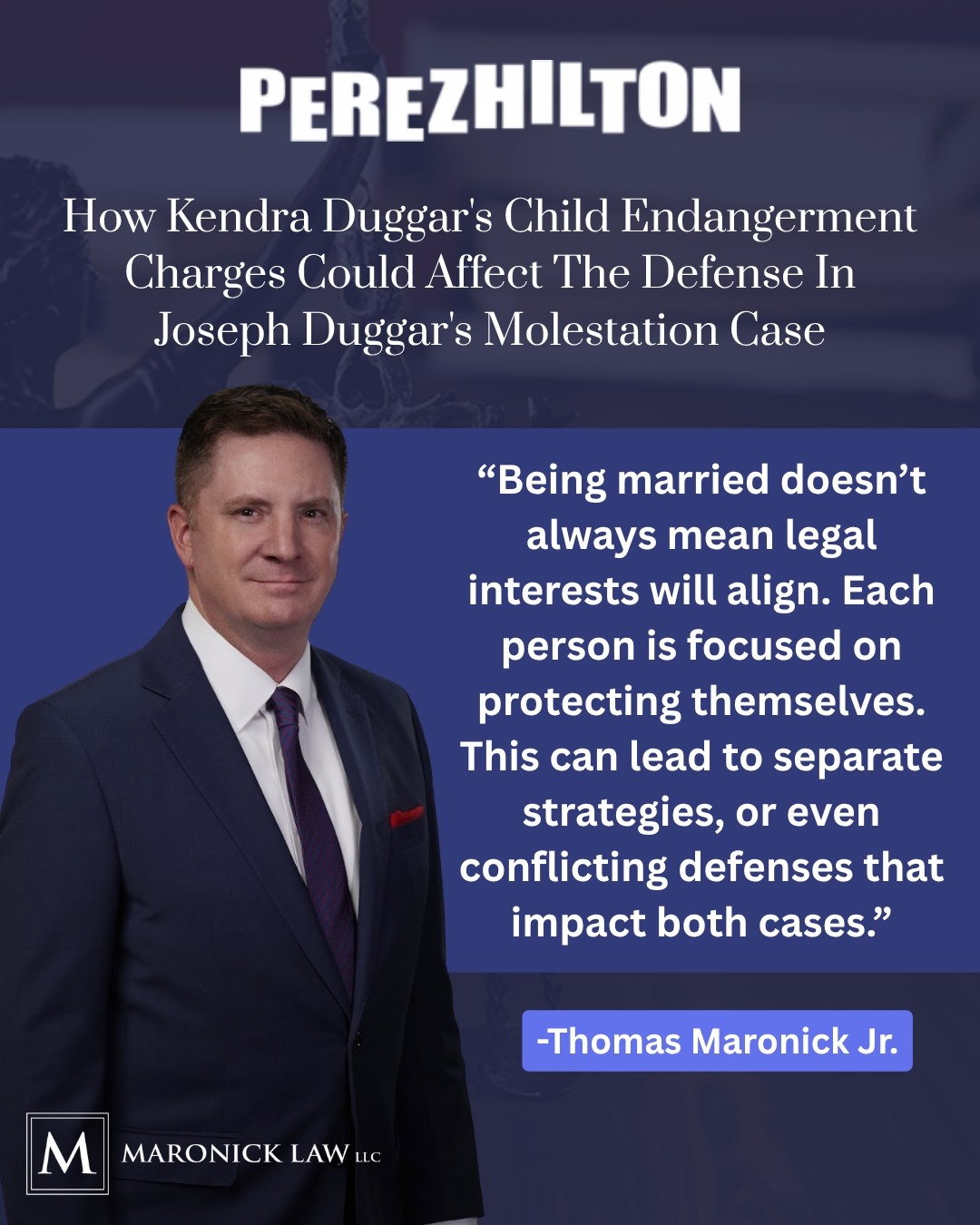
"Being married doesn't always mean legal interests will align. Each person is focused on protecting themselves. This can lead to separate strategies, or even conflicting defenses that impact both cases."
For defense counsel, that is where joint defense agreements, severance motions, careful invocation of marital communications privilege, and coordinated discovery strategy go from textbook concepts to survival tools. Arkansas charges endangering the welfare of a minor under Ark. Code § 5-27-205 (first degree) and Ark. Code § 5-27-206 (second degree). Prosecutors in either state can and will use prior statements from either spouse, including interviews, social media posts, and recorded calls, to construct a single overarching narrative that links the two prosecutions.
"Statements are also critical. Anything either party has previously said can be used by prosecutors not only to highlight inconsistencies, but to build a narrative that connects the two cases," Maronick told Perez Hilton.
Public perception is the third battlefield. In a case that has trailed a reality-television family for more than a decade, pretrial publicity, jury pool contamination, venue considerations, plea posture, and trial optics all move in tandem.
Maryland Sex Offense Allegations: What Can The Duggar Cases Teach Defendants In Maryland?
Sex Crime Locations Served
- Baltimore Sex Crime Lawyers
- Bel Air Sex Crime Lawyers
- Catonsville Sex Crime Lawyers
- Easton Sex Crime Lawyers
- Frederick Sex Crime Lawyers
- Glen Burnie Sex Crime Lawyers
- Ocean City Sex Crime Lawyers
- Queen Anne's County Sex Crime Lawyers
- Rockville Sex Crime Lawyers
- St. Mary's County Sex Crime Lawyers
- Towson Sex Crime Lawyers
- Westminster Sex Crime Lawyers
- Wicomico County Sex Crime Lawyers
The Duggar prosecution is unfolding in Florida and Arkansas, but the doctrines are the same ones that decide cases in Glen Burnie, Baltimore, Towson, Ocean City, Rockville, Westminster, Easton, and Bel Air. Under Maryland law, sexual abuse of a minor is codified at Md. Code, Criminal Law § 3-602, with related offenses under § 3-307 and § 3-308. Maryland is a two-party consent state under the Maryland Wiretap Act, Md. Code Cts. & Jud. Proc. § 10-402, though the statute authorizes law-enforcement-coordinated one-party consent recordings for an enumerated list of serious offenses that includes sexual abuse of a minor, child abuse, and rape. Child endangerment-style conduct in Maryland is typically charged under Md. Code, Criminal Law § 3-601 (child abuse) and related neglect provisions.
Three lessons from the Duggar cases apply to anyone who suspects they are under investigation:
- Recorded conversations are evidence. A call from a relative, a former friend, or someone who claims they just want to understand what happened is often a pretext call coordinated with detectives. Every word is being preserved.
- Apologies, reflections, and statements of remorse can be reframed as inculpatory admissions. Prosecutors do not need a full confession. They need language they can hand to a jury inside a coherent narrative.
- Retain criminal defense counsel before your first interview, not after. The suppression motions, severance motions, Miranda challenges, pretrial publicity motions, and probable cause attacks that actually move these cases are built during the first 72 hours of contact with law enforcement.
Similar Post: What Are Your Rights If Police Interrogate You About a Sex Crime Without a Lawyer Present?
Maryland Criminal Defense Attorney: Call Tom Maronick Jr. Before Prosecutors Build Their Case
If you have been contacted by a detective, received a target letter, been served with a search warrant, or learned that a spouse, relative, or close associate is cooperating with investigators, the time to retain criminal defense counsel is immediately. Maronick Law LLC defends clients facing felony sex offense allegations, child sexual assault charges, inappropriate touching accusations, pretext call fallout, co-defendant spousal prosecutions, and high-profile, media-adjacent criminal matters throughout Maryland, with offices in Glen Burnie, Baltimore, Ocean City, Westminster, Towson, Bel Air, Rockville, and Easton.
Call 443-551-2747 or submit an online contact form for a confidential consultation. Maronick Law LLC is available 24/7 including nights, weekends, and holidays.
Disclaimer: This blog is intended for informational purposes only and does not establish an attorney-client relationship. It should not be considered as legal advice. For personalized legal assistance, please consult our team directly.