



Memorial Day weekend has a feel of its own across Maryland. Bar patios fill up by 4 p.m. Brewery taprooms run hour-long waits. Boat slips around the bay sit packed by lunch. And by 10 p.m., one question keeps surfacing in every group: who is driving home?
That single decision, sometimes made after the third or fourth drink, is the one Maryland's DUI laws are built around. A Maryland DUI checkpoint over Memorial Day is one of the most common places where a fun night turns into a long, expensive problem. If a stop happens to you this weekend, what you understand about the law in the next ten minutes can shape what happens for the next ten months.
This blog walks through how Memorial Day drinking culture collides with Maryland DUI enforcement, what really happens at a stop, and the choices that tend to make the biggest difference. If you have already been stopped, charged, or arrested after going out this weekend, call Maronick Law LLC at 443-551-2747 or fill out the contact form on our website. The earlier you get guidance, the more you can protect.
Memorial Day Drinking Culture: How Does A Casual Night Out Lead To A DUI Stop?


Most DUI cases do not start with someone being reckless. They start with someone who thought they were fine. You meet friends for happy hour. The first round goes down quickly because the bartender is fast and the weather is warm. By the time the food shows up, you are already a drink deep without realizing it. A toast. A buyback. A top-off. Two hours later, you do the math in your head and decide you can drive.
That moment, the one where you decide you can drive, is where most Maryland DUI cases begin.
A few patterns show up over and over in cases tied to Memorial Day weekend:
- Underestimating pace: Drinks served on outdoor patios go down faster than you track
- Hidden cocktail strength: Specialty drinks often carry more alcohol than the menu suggests
- Food buffer myth: Eating during drinking slows absorption but does not stop it
- Cooling-off illusion: Sitting at the bar for 30 minutes does not always lower your BAC
These are the kinds of details that get pieced together later by an officer, a prosecutor, and sometimes a defense attorney trying to explain how someone with a clean record ended up in a holding cell on a Saturday night.
Maryland BAC Limits: What Does The Legal Threshold Actually Look Like In Real Drinks?
Maryland law sets the per se DUI threshold at a blood alcohol concentration of 0.08 percent for drivers 21 and older, and 0.02 percent for drivers under 21. A separate DWI charge under Maryland Transportation Article § 21-902(b) can apply at lower levels when alcohol affects how you drive.
The challenge is that the legal limit is much easier to hit than most people realize. Body weight, food intake, the speed of drinking, and the actual strength of what you ordered all change the equation. A craft IPA can carry nearly twice the alcohol of a domestic light beer. A single cocktail at a busy bar can come with a heavier pour than you would get at home. And alcohol from earlier in the day, like a sangria at lunch, may still be in your system when you start the evening round.
By the time you have had three or four drinks over a few hours, you may be well above 0.08 even if you feel completely fine. The law does not care how you feel. It cares what the test says.
Maryland DUI Checkpoint Stops: What Should You Expect After Leaving A Bar?
Sobriety checkpoints are legal in Maryland under both state law and U.S. Supreme Court precedent, as long as officers follow neutral procedures (like stopping every third or fifth vehicle) and the location is pre-approved. Over Memorial Day weekend, you can expect to see them positioned near busy nightlife corridors and along the main routes leaving popular bar areas.
When you roll up after leaving a bar, officers are watching for things you may not even notice yourself. The smell on your breath. The way you fumble for your wallet. Whether your eyes track when they ask for your license. A pause that feels normal to you may look like impairment to someone trained to spot it.
If anything raises suspicion, you may be directed to a secondary area for additional questions or field tests. From that moment, the situation moves quickly. What you say, what you agree to, and what you decline all become part of the file.
If you find yourself in that moment over Memorial Day weekend, your best move is to stay calm, be polite, and contact Maronick Law at 443-551-2747as soon as you are able. The online contact form on our website is available around the clock for anyone who needs to reach out outside of business hours.
- ★★★★★
I recently had Mr. Maronick represent me for my first DUI case. I was very nervous about it because of the results of the DUI incident. The outcome that I was initially looking at was jail time, high fines and a license suspension. He got me out of jail time, I got probation, and the fines were thrown out. All I ended up having to pay were court costs. He really did his job, and I am very appreciative of that. I highly recommend him to be hired for your DUI case or any others you may have.
Myeshia - ★★★★★
Late last year I found myself in a position that I clearly had no ability to get out of on my end. Yes, you guessed it right I caught a DUI. Feeling ashamed and embarrassed I immediately put those feelings to the side and contacted the Maronick Law Firm. From the initial consultation, Tom made me feel at ease about my situation and instructed me on everything to do before my court date I ended up getting the DUI charge dropped to a PB - no points on my license or charges on my record, just a fine and 2yrs probation. To anyone going through a similar scenario, I highly recommend you reach out to the Maronick Law Firm.
Brandon See All Client Reviews
Maryland Implied Consent Law: What Happens When An Officer Asks You To Blow?
Maryland has an implied consent statute under Transportation Article § 16-205.1. The idea is simple. By driving on Maryland roads, you have already agreed to take a breath or blood test if an officer has reasonable grounds to believe you have been drinking and asks you to submit.
This is different from field sobriety tests. The walk-and-turn, the one-leg stand, and the eye-tracking test are voluntary. You can decline them without facing an automatic license penalty, although officers can still use their observations to support an arrest.
The chemical test is different. If you refuse the breath or blood test after a lawful arrest:
- License suspension: A first refusal triggers a 270-day suspension of your driving privileges
- Repeat refusals: A second refusal can lead to a two-year suspension
- Evidence at trial: Prosecutors can tell the jury you refused, which often hurts the defense
- Ignition interlock alternative: Some drivers may qualify for an interlock program in place of full suspension
Refusing is not a magic exit. It is a legal choice with its own consequences, and the right decision depends on the specific facts of what is actually happening in that moment.
DUI Versus DWI Maryland: Why Does The Distinction Matter The Morning After?
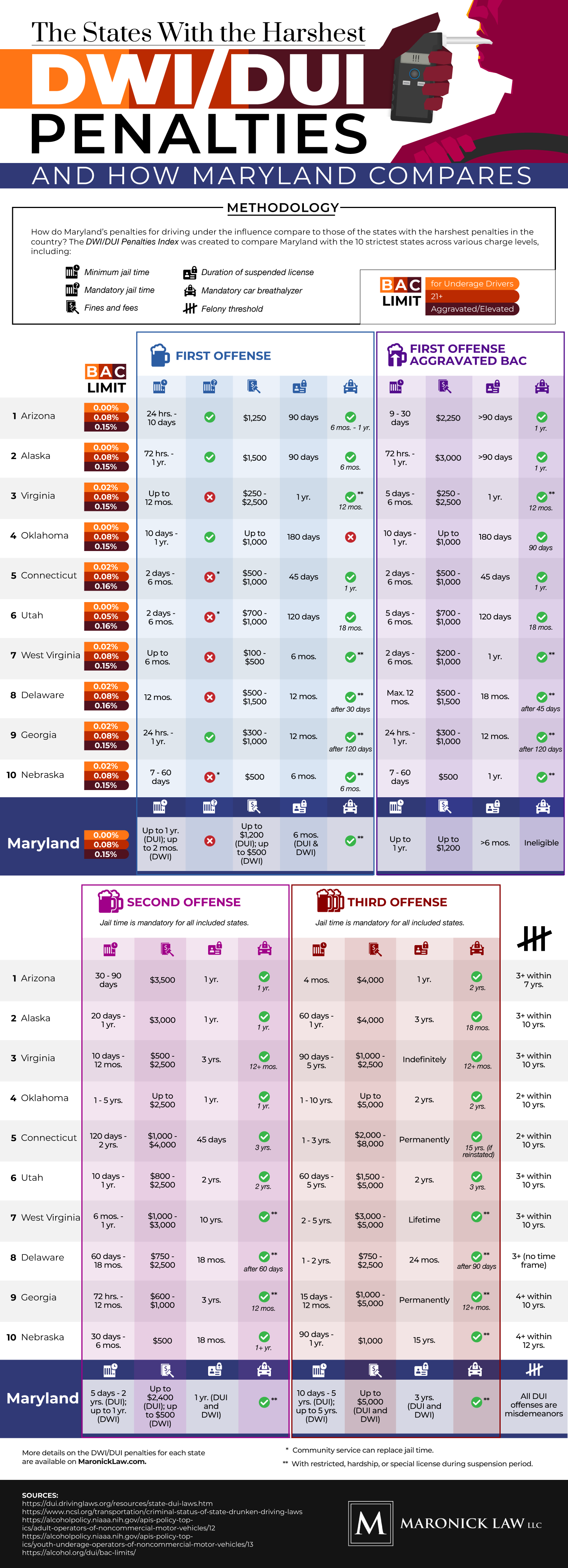
Maryland separates impaired driving into two main charges. A DUI charge under Transportation Article § 21-902(a) is the more serious of the two. It usually applies when your BAC is 0.08 or higher, or when impairment is significant. A DWI charge under § 21-902(b) is the lesser charge, often used when alcohol affected your driving but the BAC came in lower or the evidence was less clear cut.
The difference matters because:
- DUI penalties: Up to one year in jail and fines reaching $1,000 for a first offense
- DWI penalties: Up to 60 days in jail and fines up to $500 for a first offense
- License points: A DUI adds 12 points, while a DWI adds 8
- Insurance impact: A DUI on your record affects premiums much longer than a DWI
The charge you are initially booked under is not always the charge you end up convicted of. Many cases get reduced or restructured through defense work, which is part of why what happens in the first 48 hours can change everything.
The Morning After A DUI: How Does One Night Out Affect Your License, Job, And Insurance?
A DUI charge does not end with the arrest. The fallout starts almost immediately and tends to reach further than people expect.
In the days and weeks after a Memorial Day DUI charge, you may face:
- License consequences: Administrative suspension can begin before your court date
- Employment fallout: Jobs that require driving, security clearances, or clean records can be jeopardized
- Insurance hikes: Carriers often raise premiums significantly or drop coverage entirely
- Professional licensing: Nurses, teachers, contractors, and others may face board-level review
For most people, the financial weight of a DUI goes well beyond the fine itself. Lost wages, higher premiums, court fees, and possible treatment requirements add up faster than the original night ever cost.
Similar Post: How Do I Get a Restricted License for Work if My Maryland Driver’s License is Suspended?
Going Out Smarter Memorial Day: What Choices Make The Biggest Difference?
You can plan your Memorial Day weekend in a way that keeps a DUI off your radar entirely. None of this is complicated, but each piece matters.
A few practical habits go a long way:
- Build the ride home first: Set up a rideshare, designated driver, or hotel before the first drink
- Pace yourself with water: Alternating drinks with water helps you read your own body more accurately
- Skip the last-call rush: The drink between midnight and close is often the one that pushes BAC past the line
- Stay put if needed: If the night runs long, plan to stay where you are or get picked up
Memorial Day weekend is a long stretch, and decisions made early in the evening tend to be the ones that protect you most by the end of it.
Similar Post: How Can a Maryland DUI Lawyer Help Me Avoid Jail Time for a First Offense?
FAQs About Maryland DUI Stops And Going Out on Memorial Day Weekend
Can I be charged with a DUI in Maryland if I was below 0.08? Yes. A DWI charge can apply at lower BAC levels if alcohol affects your driving, and certain other situations can lead to charges even without a per se reading.
Are bars and restaurants liable if a customer drinks too much and drives? Maryland generally does not recognize traditional dram shop liability in the same way as some other states, but related claims can come up in cases involving serious injury.
Do I have to take a field sobriety test if asked? No. Field sobriety tests are voluntary, although declining them does not stop an officer from making an arrest based on other observations.
What if I was only buzzed when I drove? Maryland law focuses on impairment and BAC, not how you describe your own state. Even a small amount over the limit can lead to a charge.
Will a DUI from Memorial Day weekend show up on background checks? Yes. A conviction generally shows up in employment, housing, and licensing background checks unless specific legal steps are taken to address it.
Can I get my charges reduced or dismissed? It depends on the facts of your case. Procedural errors, evidence problems, or weak grounds for the stop can all create options for the defense.
Ocean City DUI Checkpoint Over Memorial Day Weekend: Take The Next Step With Maronick Law LLC
A single decision after a night at the bar can change the next year of your life. The drink you almost did not order. The rideshare you decided to skip. The moment you turned the key thinking you were fine. By Tuesday morning, those choices may be sitting in a charging document on a kitchen counter.
The most useful steps in the hours after a DUI charge are also the simplest:
- Stay calm: Avoid making statements until you have legal guidance
- Document everything: Write down what you remember while it is fresh
- Save paperwork: Hold onto every form handed to you at the scene
- Get legal help fast: Maryland DUI timelines move quickly, and early action matters
You do not have to navigate the days after a Memorial Day DUI on your own. If you were stopped or charged in Ocean City, Maryland this weekend, call Maronick Law LLC at 443-551-2747 or use the online contact form on our website to share what happened. We will walk you through what comes next and help you protect what matters.
Disclaimer: This blog is intended for informational purposes only and does not establish an attorney-client relationship. It should not be considered as legal advice. For personalized legal assistance, please consult our team directly.