


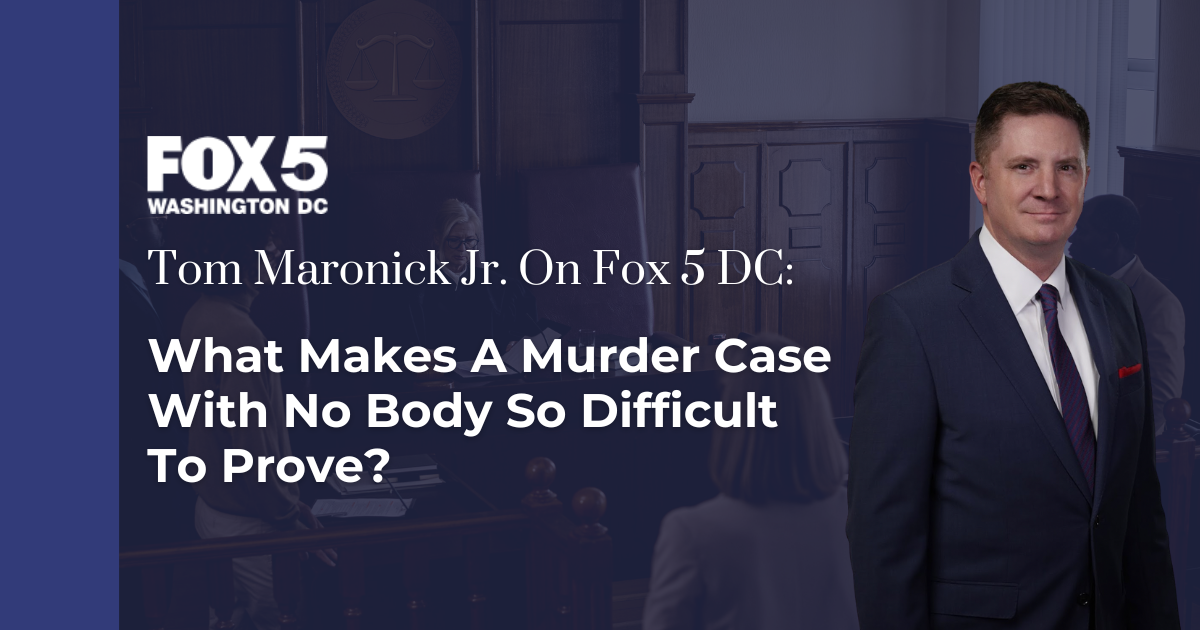
Behind every headline about a missing person is a family waiting for answers. Mamta Kafle Bhatt disappeared from Manassas Park, Virginia, in the summer of 2024, and two years later her loved ones are still holding vigils and hoping for resolution. When a case like hers reaches the news, people understandably want to make sense of what is happening in the courtroom, which is why Maryland criminal defense attorney Tom Maronick Jr. recently joined Fox 5 DC to help explain one of the hardest situations a court can face: a no body murder case.
These cases are painful for everyone they touch, and they are also genuinely complex under the law. If you or someone you love is facing a serious charge, learning how the process works can bring a little clarity during a frightening time. A knowledgeable Maryland criminal defense attorney can walk you through what the state has to prove, how the rules are meant to protect anyone who is accused, and what reasonable doubt really means. If you have questions about a charge you or a family member is facing, please reach out. You can call Maronick Law LLC at 443-551-2747 or use our online contact form to speak with someone who can help.
No Body Murder Cases In Maryland: How Do Prosecutors Prove A Case Without Remains?
Many people assume a murder charge cannot move forward without a body. That is not the case. Prosecutors in Maryland, like their counterparts in Virginia, can bring a homicide case even when a person has never been found. What changes is not whether the case can proceed, but how carefully the state has to build it.
In most homicide cases, investigators rely on the physical evidence a body can provide. As Tom Maronick Jr. explained in his commentary, a medical examiner can often point to specific findings and describe what they suggest about how a person died, whether that points toward strangulation, a weapon, or another cause. In a case with no remains, that information simply does not exist, and the state loses the physical proof it would normally use to establish how a death occurred.
That absence changes the entire approach. Instead of relying on medical findings, prosecutors have to trace the timeline of events, account for the movements of the accused, and try to connect what happened during the period in question. When those pieces do not fit together clearly, the law places the responsibility on the state to resolve that uncertainty, not on the accused to explain it away. Making sure the state meets that responsibility fully and fairly is part of what a defense attorney is there to do.
Circumstantial Evidence In A Murder Case: What Does It Take To Prove Guilt?
Circumstantial evidence is often misunderstood, and people sometimes assume it carries little weight. In reality, most serious cases rely on it to some degree, and the law does not treat it as inferior to direct evidence. Circumstantial evidence is proof that points toward a conclusion without stating it directly, and a jury may be asked to draw a reasonable inference from a pattern of facts. Courts instruct jurors that direct and circumstantial evidence carry equal weight, which means a case can be built largely, or even entirely, on inference and still support a conviction.
In the Bhatt case, prosecutors have reportedly pointed to store purchases, surveillance footage, and a large volume of digital records, in a prosecution notable for proceeding without a recovered body. Court filings have since described forensic material recovered from a saw, including several human hairs that investigators say may be suitable for nuclear DNA testing and have referred to the state laboratory for analysis. A case built this way depends on a jury being persuaded that the inferences hold together as a whole. The standard for conviction, proof beyond a reasonable doubt, is the same as in any criminal case, but here it must be met through the accumulated weight of that evidence rather than a single direct account. That is why every part of the state's version has to be examined with care.
Here is what the state generally has to establish in a circumstantial homicide case:
- A death occurred: The evidence must show the person has died and did not simply leave or lose contact
- A criminal act caused it: The proof must point to a killing rather than an accident or natural cause
- The accused was responsible: The state must connect the defendant to the death beyond a reasonable doubt
- Intent supports the charge: For first-degree murder, the evidence must reflect a willful, deliberate, and premeditated act
Each of those elements deserves close and fair scrutiny. Juries are instructed that a person cannot be convicted on suspicion or conjecture, and that the state must prove every element of the offense beyond a reasonable doubt; if the evidence as a whole leaves a reasonable doubt, that doubt must be resolved in the defendant's favor. That safeguard exists to protect everyone.
Why Tom Maronick Jr. Was Asked To Explain This Case On Fox 5 DC: What Does Legal Commentary Really Offer?
There is a reason a station like Fox 5 DC turns to an experienced trial lawyer when a difficult case is in the news. Reporters are not trying to convict or exonerate anyone. They are trying to help the public understand a painful and confusing situation, and that calls for someone who can explain the process calmly and clearly.
When Tom Maronick Jr. discusses a case with no body on air, he is doing the same thing he does for clients every day, which is focusing on what the evidence can and cannot show, and reminding people that an accusation is not the same as proof. That kind of measured, courtroom-tested perspective is why local outlets continue to reach out, and it reflects years of handling serious cases across Maryland with care.
For anyone facing charges, that steadiness matters. What helps most is not bravado, but a lawyer who can look at a case the way a jury will, understand where the real questions lie, and explain honestly what the road ahead may hold.
Digital Evidence And Reasonable Doubt: How Does A Defense Review So Much Data?
Modern homicide cases increasingly turn on digital evidence. In the Bhatt matter, court filings reportedly describe more than 1.5 terabytes of material, including video, recordings, photographs, and documents, gathered with the help of what the defense described as no fewer than eight agencies, alongside phone records and search history reported elsewhere in the case. That volume can feel overwhelming to everyone involved.
A careful defense does not treat that much data as an answer in itself. It treats each piece as something that has to be understood in context. Where did a piece of footage come from, and does it show what it appears to show? Was a search made by the accused, or by someone else with access to a device? Does a phone record place a person somewhere, or only place the device there? These are not loopholes. They are the honest questions that determine whether the evidence means what it seems to mean.
This is also why time and preparation matter so much. Reviewing this much material takes months, and rushing it serves no one. An attorney who understands digital discovery knows how to consider the full picture, not only the portions the state has chosen to highlight.
Facing A Serious Charge In Maryland: What Steps Should You Take Early?
If you or a family member is under investigation or already charged, the decisions made in the first days can shape everything that follows. The goal is simply to protect your rights while the process moves forward.
- Stay calm and quiet: It is usually wiser to remain silent than to try to explain your way through a stressful moment
- Preserve your records: Keep any documents, messages, or receipts that may help tell your side of events
- Be careful online: Posts and messages can be taken out of context, so it is best to step back from social media
- Reach out early: The sooner a lawyer is involved, the more can be done to look out for you
Contacting a lawyer early is not an admission of anything. It is simply a way to make sure someone is looking out for your interests from the very beginning. A short conversation with Maronick Law LLC can help you understand where you stand and what may come next.
Serving Maryland Communities: Where Can You Reach Maronick Law LLC?
High-profile cases draw attention across the region, but the people who need a criminal defense attorney are usually much closer to home. Maronick Law LLC serves clients throughout Maryland, with offices reaching from Baltimore and Towson to Glen Burnie, Westminster, Rockville, Bel Air, and the Eastern Shore in Easton and Ocean City.
Whether a case is heard near the Baltimore Beltway, along the I-95 corridor, or in a county circuit court across Central Maryland, the commitment is the same. Every person deserves a defense that takes the evidence seriously and treats everyone involved with respect. If you are facing a difficult moment, reaching out early gives your attorney the time to help you the most.
Frequently Asked Questions About No Body Murder Cases
Can you be convicted of murder in Maryland without a body?
Yes. Maryland law allows a murder conviction based on circumstantial evidence, so a missing body does not end a case. It does make the state's job harder, because prosecutors must prove a death and its cause without physical remains.
What is circumstantial evidence in a murder case?
Circumstantial evidence is proof that points toward a conclusion without stating it directly, such as purchases, surveillance footage, or records. A jury is asked to draw reasonable inferences from it, and each part can be examined closely.
Why does the media ask a Maryland criminal defense attorney to comment on cases like this?
Reporters want a clear, courtroom-tested explanation of what is happening without taking a side. An experienced trial attorney can describe reasonable doubt, the burden of proof, and how a murder case without a body is built.
How does a defense lawyer review large amounts of digital evidence?
By understanding where the data came from, who created it, and what it truly shows. Large volumes of digital discovery take time to review carefully, which is one reason early preparation matters so much.
Talk With A Maryland Criminal Defense Attorney Today
A charge built on circumstantial and digital evidence is serious, but it is not the same as a conviction. The state still has to prove every element beyond a reasonable doubt, and that is where a thoughtful, experienced defense matters. If a case in the news has left you worried about what a charge could mean for you or someone you love, you do not have to sit with that worry alone.
Please call Maronick Law LLC at 443-551-2747 or reach out through our online contact form to speak with a Maryland criminal defense attorney about your situation. The sooner you connect with a lawyer who handles serious cases, the sooner you can begin to understand your options and move forward.
Disclaimer: This blog is intended for informational purposes only and does not establish an attorney-client relationship. It should not be considered as legal advice. For personalized legal assistance, please consult our team directly.