


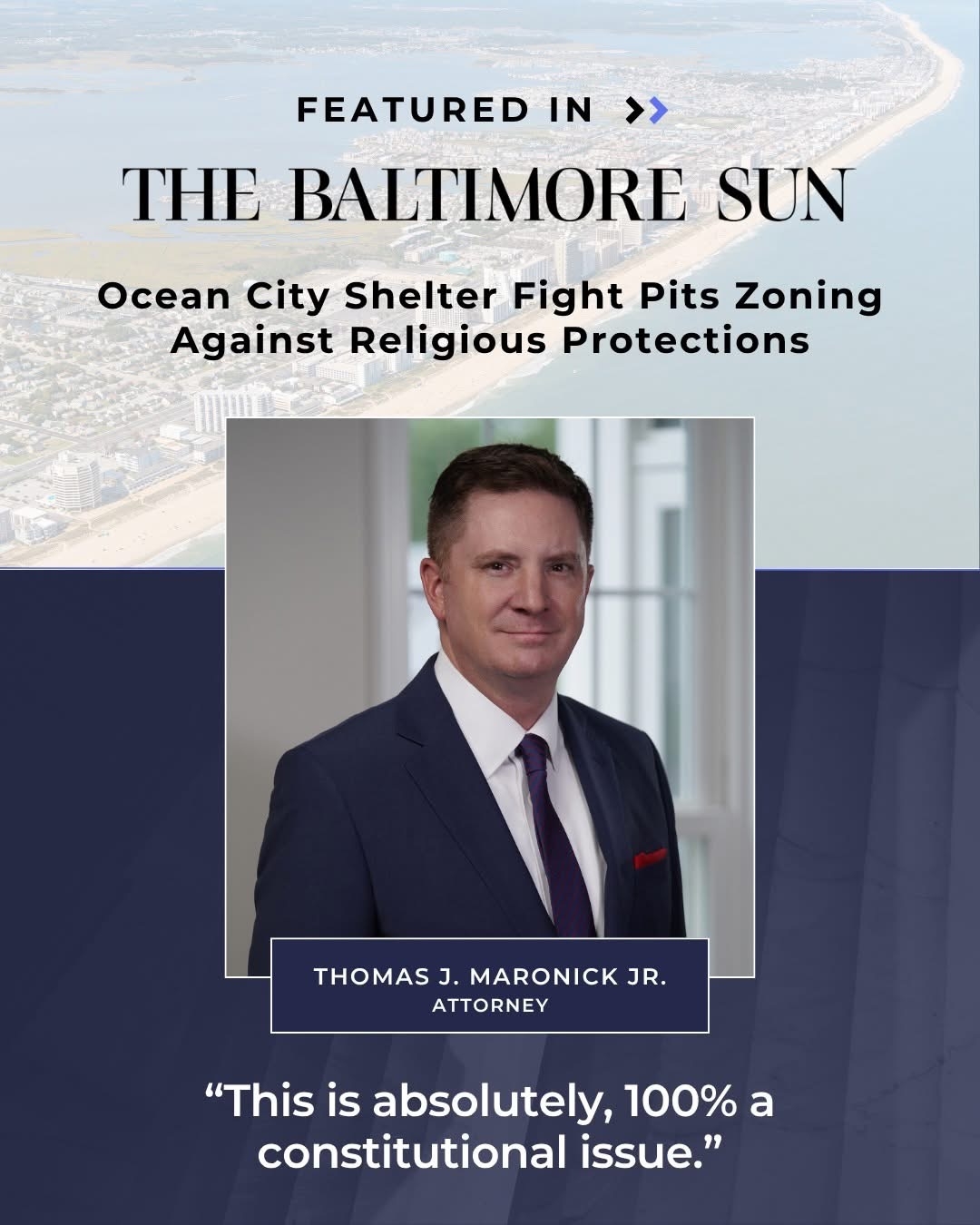
If you have followed the news in Ocean City this spring, you have probably read about the Episcopal church near City Hall that is refusing to close its overnight shelter, even after a town order to shut its doors by June 8. The story has reached beyond the Boardwalk because it raises a question that an Ocean City Maryland attorney sees often: what happens when a local zoning code points one direction and a federal religious protection points the other?
Cases like this can feel confusing for the people inside them. A pastor, a congregation, neighbors, and town officials are working with the same facts but reaching very different conclusions about who has the legal high ground. If you are facing a similar situation in Worcester County or anywhere on the Eastern Shore, you deserve a plain-English explanation of the law and a knowledgeable Maryland attorney who can help you weigh your options. To talk through your situation, call Maronick Law LLC at 443-551-2747 or reach out through the free online contact form.
The Ocean City Shelter Dispute: Why Is This Case Drawing Statewide Attention?
Rev. Jill Williams, rector of St. Paul's By-the-Sea Episcopal Church, says her congregation will not close the indoor shelter that opened on March 31. The town first asked the church to remove tents outside the property, then turned its attention to the assembly hall that the congregation converted into overnight sleeping quarters. According to Williams, the shelter can house up to 34 people, with extra cots during overflow nights, and the church served 73 meals on one recent Tuesday.
Ocean City officials argue that the indoor sleeping use was created without proper approvals, and that the building must follow standard rules for zoning, occupancy, building safety, and fire code. To Williams, providing shelter is part of the church's ministry, no less religious than what happens during a Sunday service.
That friction point drew commentary from Ocean City attorney Tom Maronick Jr., who told The Baltimore Sun that the dispute would not be settled at the local level. As he put it, the case is "absolutely, 100 percent a constitutional issue." His view, drawn from years of trial work in Maryland courts, is that once the people moved from tents on the lawn into the church building itself, the town's regulatory leverage gets significantly weaker.
Maryland Religious Land Use Attorney Commentary: What Did Tom Maronick Jr. Say About The Town's Position?
Maronick noted that Ocean City had a stronger legal position when the issue involved tents outside the property, since outdoor encampments raise health and safety concerns that the town can address through ordinary land use enforcement. Once the activity moved indoors, the legal landscape changed.
"They're allowed to do that under religious exemptions that have long been standing because the government cannot establish or interfere with the free exercise of religion," Maronick told reporters. He called it "not even a close call," given how courts have treated similar facts in other states.
This kind of public legal analysis is something Maronick is known for. He has appeared in national and regional media to discuss high-profile criminal and constitutional matters, and serves clients from offices in Ocean City, Baltimore, Glen Burnie, Towson, and across Maryland. His comments on the St. Paul's matter reflect the same approach his clients receive in private cases: honest, plain-English analysis grounded in current law.
Free Exercise Clause Maryland: How Does The First Amendment Protect Religious Activity?
The First Amendment to the United States Constitution has two religion clauses. The Establishment Clause prevents the government from setting up an official religion. The Free Exercise Clause prevents the government from prohibiting the free exercise of religion. Both apply to state and local governments in Maryland through the Fourteenth Amendment.
For a Maryland church, mosque, synagogue, or temple, the Free Exercise Clause has real teeth. A town cannot single out religious practice for harsher treatment than comparable secular activity. If a town allows other groups to use a building for overnight stays, it cannot forbid the same use just because the host happens to be a church.
Maryland courts also consider Article 36 of the Maryland Declaration of Rights, a longstanding religious liberty provision, which supports strong safeguards for sincerely held religious practice across the state.
Religious Land Use Law In Maryland: Why Does RLUIPA Carry So Much Weight In A Case Like This?
Beyond the First Amendment, Congress passed the Religious Land Use and Institutionalized Persons Act in 2000. Lawyers call it RLUIPA. Two parts of the statute help explain why Tom Maronick Jr. and other Maryland legal commentators believe Ocean City would have a hard time prevailing if the dispute reaches a federal courtroom.
The substantial burden provision, codified at 42 U.S.C. Section 2000cc(a), prohibits a state or local government from imposing a land use regulation that substantially burdens religious exercise unless the government can show a compelling interest and that the rule is the least restrictive means of achieving it. That standard, sometimes called strict scrutiny, has tripped up many municipalities since the law went on the books.
The equal terms provision, at 42 U.S.C. Section 2000cc(b), bars governments from treating a religious assembly on less than equal terms with a nonreligious assembly. If a town allows a hotel, dormitory, or community center in a given district but forbids a church from doing something comparable, the equal terms clause is potentially in play.
RLUIPA matters because it gives federal courts a clear framework for reviewing local zoning decisions that touch on places of worship, and judges in the United States District Court for the District of Maryland have applied it in similar disputes. The statute also allows successful plaintiffs to recover attorney fees, which is one reason Maronick and other observers have said towns can face real financial exposure when they lose these cases.
How A Maryland Religious Land Use Dispute Tends To Reach The Courts: What Comes Next In The Ocean City Case?
When a Maryland church and a local town cannot work out a zoning fight on their own, the dispute usually ends up in court. The town typically sends a notice of violation, then a citation, then asks a judge to enforce the order. The church can push back, raise its First Amendment and RLUIPA defenses, or even file its own lawsuit in federal court asking a judge to block enforcement before it happens.
That second move is what Tom Maronick Jr. has been hinting at in his public comments. He has pointed out that the dispute will not be settled at the local level. Once a case like this lands in federal court, the legal questions shift to ones that towns historically have a very hard time winning.
Tom Maronick Jr. On Ocean City Religious Land Use: Why Could This Case Shape Maryland Disputes Far Beyond The Boardwalk?
When Maronick spoke with reporters about the St. Paul's dispute, he did not treat it as a one-off Ocean City story. He treated it as a constitutional question with consequences well beyond the Boardwalk. That broader read is what makes his commentary on the case worth paying attention to.
Maronick's view comes from years of trial work and constitutional analysis in Maryland courts. He has appeared in national and regional media on high-profile criminal and constitutional matters, and he tends to call the legal landscape the way he sees it, even when his analysis cuts against a town's position. In this case, he put it plainly: once the people moved indoors, the town's regulatory leverage got significantly weaker, and the religious exemption got stronger. To Maronick, it is "not even a close call."
A federal ruling in Ocean City, or even a strong settlement, would give other Maryland congregations a clearer sense of what they can and cannot do on their own property. It would also give towns up and down the Eastern Shore a sharper picture of how far their zoning codes can reach when a church is on the other side of the table. Maronick's commentary helps frame why those stakes are real.
Frequently Asked Questions From People Facing A Maryland Religious Land Use Dispute
What is RLUIPA, and does it apply to a Maryland zoning dispute? RLUIPA is the federal Religious Land Use and Institutionalized Persons Act. It applies to land use decisions by state and local governments throughout Maryland, including Ocean City and other Worcester County jurisdictions. If a zoning rule places a substantial burden on religious exercise, the town must show a compelling interest and that the rule is the least restrictive means of meeting it.
Can a Maryland church run a homeless shelter on its property? In many cases, yes. A Maryland church may have a strong argument that sheltering people in need is part of its religious mission, which is protected under the First Amendment, RLUIPA, and Article 36 of the Maryland Declaration of Rights.
Why is the Ocean City church shelter case getting so much attention? The case combines a visible local dispute, a clear federal constitutional question, and a sympathetic community service. It is the kind of fact pattern that often ends up shaping how other Maryland towns handle similar disputes.
Tom Maronick Jr. On Maryland Legal Commentary: Where Can You Reach Him For Analysis On Developing Stories?
Stories like the St. Paul's By-the-Sea shelter dispute often need a clear, plain-English legal voice on tight deadlines. Tom Maronick Jr. is a frequent media commentator on Maryland constitutional, criminal, and civil matters, offering analysis that helps reporters and readers understand what is actually at stake.
To reach Tom for commentary, an interview, or background analysis, call Maronick Law LLC at443-551-2747 or use the online contact form to get started.
Disclaimer: This blog is intended for informational purposes only and does not establish an attorney-client relationship. It should not be considered as legal advice. For personalized legal assistance, please consult our team directly.