

You've read the headlines. You've seen the court sketches. You've probably formed an opinion, one way or another, about Luigi Mangione, the Ivy League-educated data engineer accused of fatally shooting UnitedHealthcare CEO Brian Thompson in Midtown Manhattan in December 2024. But there is one voice in this case that carries a perspective most legal commentators simply don't have: a Baltimore-area attorney who knew the Mangione family for over two decades.
That attorney is Tom Maronick Jr., founding senior partner of Maronick Law LLC and his observations, now featured in a March 2026 deep-dive by Oxford University's student newspaper, add a deeply human dimension to one of the most talked-about criminal cases in recent American history.
If you or someone you know is facing serious criminal charges in Maryland, Maronick Law LLC offers free consultations. Call us at 443-551-2747 or contact us online.
Luigi Mangione Family Background: Who Are the Mangiones of Baltimore?
For readers outside the Baltimore area, the Mangione name may only mean one thing right now. But in Maryland, it carries a very different weight.
The Mangione family has deep roots in the Baltimore community. Public figures within the family include Maryland State Delegate Nino Mangione and former Loyola Men's Soccer Hall of Famer Sam Mangione. The family has long been associated with charitable giving, community involvement, and civic engagement, including ownership of local country clubs and the radio station WCBM, where Tom Maronick Jr. himself once hosted a talk show.
When news broke that Luigi Mangione was the suspected shooter, Maronick's reaction was immediate and personal.
"When I saw the last name, I wondered if he was related to the people I knew," Maronick told Oxford University's student publication, The Oxford Student, in a March 2026 feature on the case. When he saw a photograph of the suspect in media coverage, his suspicions were confirmed. "The Mangiones have similar features, and I knew he was part of the family," he said.
His reaction? Pure shock.
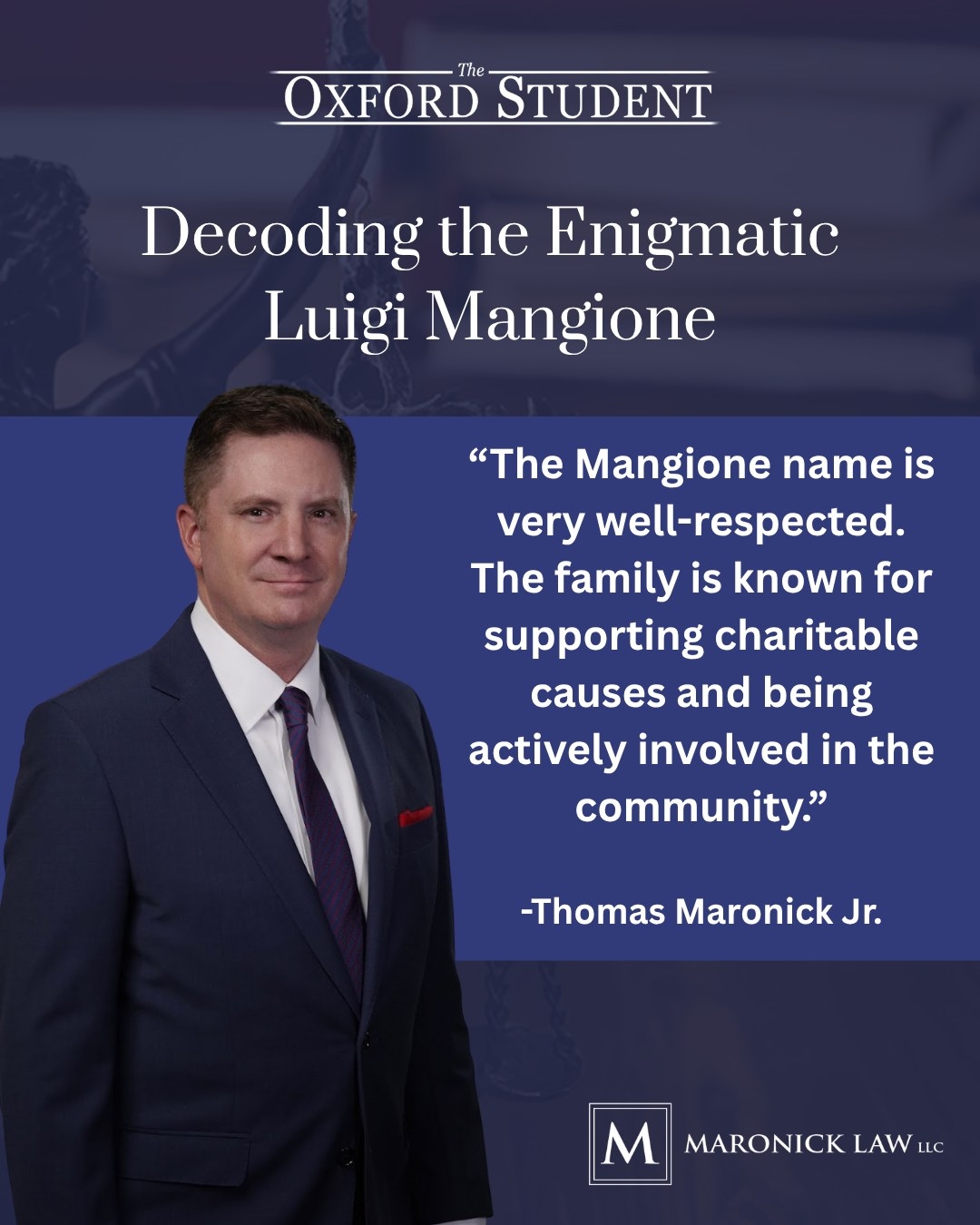
"The Mangione name is very well-respected. The family is known for supporting charitable causes and being actively involved in the community," Maronick said. "I was shocked. If you had asked me to guess who would end up in headlines [for murder], he wouldn't have been on the list."
That reaction, coming from someone with a front-row view of who this family is, says something important. It doesn't tell us whether Luigi Mangione is guilty or innocent. But it does complicate the flattened narrative that has dominated much of the media coverage, which is the idea that this case is simple, the motive obvious, and the outcome inevitable.
Luigi Mangione Legal Strategy: What Defense Options Does He Have?
Tom Maronick Jr. has been one of the most consistent legal voices on this case since the arrest, and he has covered it extensively here on the Maronick Law blog. His analysis has tracked the case through several pivotal legal moments.
On the terrorism charges, Maronick was clear-eyed. When Judge Gregory Carro dismissed the two terrorism counts, ruling that Mangione's alleged ideological motivation alone did not meet the legal threshold for terrorism under New York law, Maronick told FOX45 News: "I'm not surprised. I thought the ruling made sense. I'm not surprised that prosecutors attempted to go off the terrorism charges. I thought it was overreaching."
That observation matters legally. Overcharging is a real phenomenon in high-profile cases, and it can backfire, inflating public expectations, muddying jury instructions, and ultimately weakening the prosecution's credibility on the charges that stick. In this case, Mangione still faces second-degree murder. A conviction carries 25 years to life.
On defense strategy, Maronick has also written and spoken publicly about the likelihood of a Not Criminally Responsible (NCR) defense, arguing that given the strength of the physical evidence (including shell casings, a ghost gun recovered at the McDonald's in Altoona, Pennsylvania, and written materials), the most viable path for the defense is not to contest the facts but to contest Mangione's mental state at the time of the offense. An NCR defense shifts the central question from Did he do it? to Was he capable of understanding what he was doing?
On the Miranda and evidence suppression fight, Maronick emphasized a key legal standard: if a reasonable person in Mangione's position could not have freely walked away during police questioning at the McDonald's, Miranda protections should have applied. If they didn't, and statements were taken without proper warnings, those statements could be suppressed. The same question applies to items recovered from his backpack. This suppression fight, Maronick noted, could shape the entire trajectory of the trial long before a jury is ever seated.
Luigi Mangione Back Injury and Healthcare: What Role Did His Medical History Play?
The Oxford Student feature goes deeper than most American coverage has on one of the most important contextual threads in this case: Mangione's long history of severe back pain and his experience with the American healthcare system.
According to public records and social media posts believed to belong to Mangione, he suffered from spondylolisthesis, a condition where one vertebra slips forward over the one below it, since childhood. His condition was aggravated by a surfing accident in 2022 and reportedly underwent spinal fusion surgery in July 2023. Posts from a Reddit account believed to be his described the pain as chronic and debilitating, affecting his ability to work, to be physically active, and to maintain intimate relationships.
A UK-based spinal surgeon quoted in the article reviewed what is believed to be Mangione's X-ray and described the fusion surgery as "far from ideal," with screw placements suggesting rushed or inexperienced surgical work. He noted that Mangione likely suffered from ongoing sciatica and may need complex revision surgery, which he is unlikely to receive adequately in American incarceration.
None of this, of course, is a legal defense on its own. But it is context directly relevant to any NCR argument, and context that helps explain why this case has resonated so broadly with the American public. The prosecution alleges his motive was animus toward the insurance industry. The cartridge casings reportedly bore the words "deny," "depose," and "delay,” echoing a well-known critique of how insurers handle claims. Whether or not those allegations are accurate, the underlying frustrations they reference are real and widely shared.
High-Profile Criminal Defense in Maryland: Why Legal Commentary on Cases Like This Matters
Tom Maronick Jr.'s involvement in the public conversation around this case is not incidental. It reflects something central to what Maronick Law does and who Tom Maronick Jr. is as an attorney.
A University of Baltimore School of Law graduate and former journalist, Maronick brings a rare combination of legal acumen and communication skill to complex, high-visibility cases. He has been featured in USA Today, CNN, The Baltimore Sun, and FOX45 News as a legal analyst on the Mangione case specifically, and on Maryland criminal defense more broadly. He is a 2025 Maryland Super Lawyer, a member of the National Trial Lawyers Top 100, and holds a perfect 10.0 rating on Avvo.
His personal connection to the Mangione family gives him something no outside analyst has: genuine insight into the human being at the center of this case. Not the meme. Not the manifesto. The person from a respected Baltimore family, described by classmates as a "super nice guy," who graduated from Penn with a combined bachelor's and master's degree in four years, and who, somewhere along the way, appears to have come apart.
That's not an excuse. It's not a defense. It's just the fuller picture and it's exactly the kind of nuance that matters in a serious criminal case.
Maryland Criminal Defense Attorney: What Should You Do If You're Facing Serious Charges?
The Luigi Mangione case is a reminder of how quickly a life can unravel and how much the quality of legal representation matters when it does. Whether you are facing a misdemeanor or a felony, whether the charges are local or federal, whether the case is straightforward or complicated, you deserve an attorney who will actually engage with the facts, challenge the evidence, and fight for your rights.
That is what Maronick Law LLC does for every client, regardless of the charge.
We handle criminal defense, DUI/DWI, assault, drug crimes, sex crimes, federal offenses, and much more across all of Maryland, with offices in Baltimore, Glen Burnie, Towson, Bel Air, Westminster, Ocean City, Easton, and Rockville.
Every defendant deserves the presumption of innocence. Every case deserves serious legal attention. Call Maronick Law LLC today.
Schedule your free consultation at 443-551-2747 or submit our online contact form. We are available 24/7, including weekends, and offer payment plans.
Disclaimer: This blog is intended for informational purposes only and does not establish an attorney-client relationship. It should not be considered as legal advice. For personalized legal assistance, please consult our team directly.